Perovskite Solar Cells Explained: The Science Behind the Next Leap in Solar Power
A family of crystalline materials has moved from laboratory curiosity to serious contender in solar energy. Here is how perovskites work, why they excite researchers, and what still stands in the way.

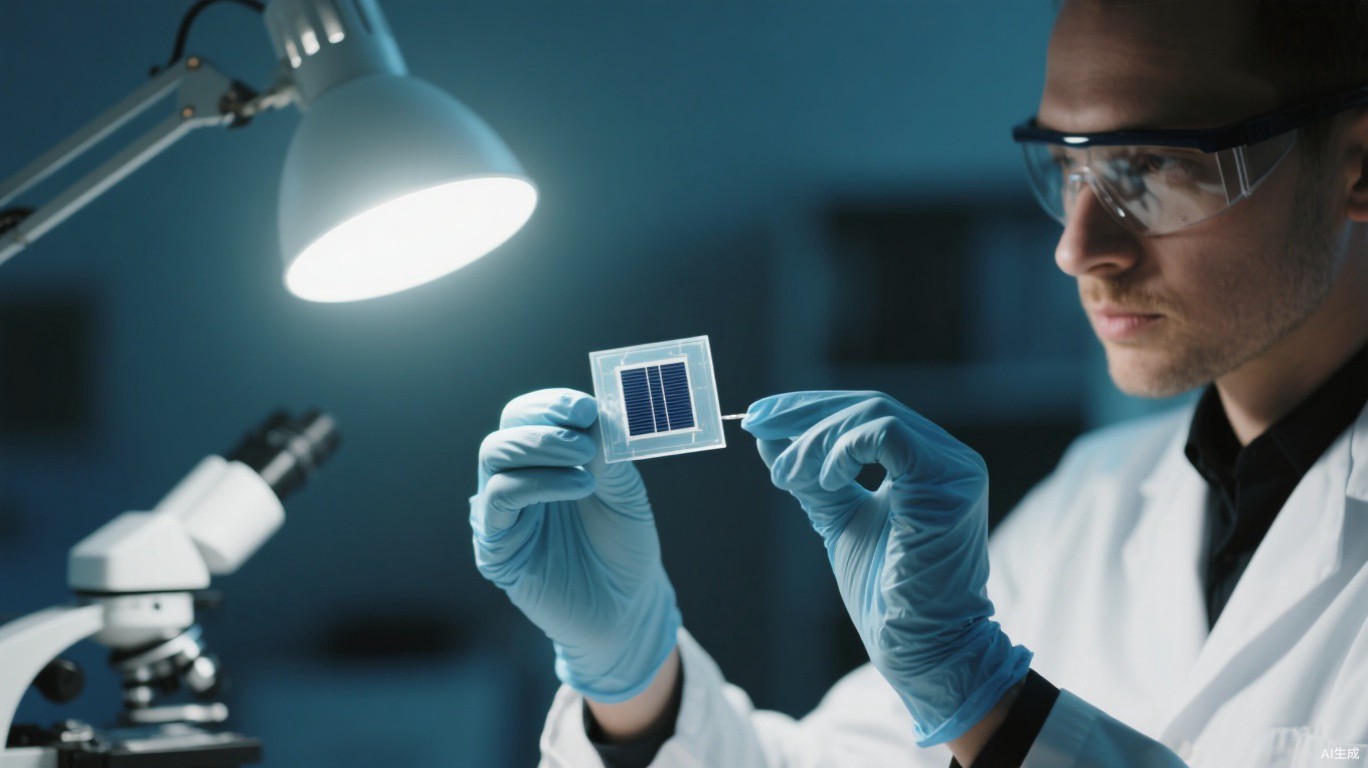
For decades, almost every solar panel installed on rooftops and in solar farms has been built from the same material: crystalline silicon. It is abundant, durable and well understood, and steady manufacturing improvements have made it remarkably cheap. Yet silicon is approaching the practical limits of how efficiently it can turn sunlight into electricity.
That is why a class of materials known as perovskites has attracted so much attention in materials science laboratories around the world. In a little over a decade, perovskite solar cells have gone from barely working to rivalling silicon in laboratory efficiency, and combined with silicon they have surpassed it.
What a perovskite is
The name refers to a crystal structure rather than a single substance. It was first identified in a naturally occurring mineral, and it describes a specific arrangement of atoms that many different compounds can adopt. The perovskites used in solar cells are usually made from a mix of organic molecules or metal ions, lead or tin, and halides such as iodine or bromine.
What makes them special is how well they handle light. They absorb sunlight strongly, so a layer far thinner than a human hair is enough to capture most of it. Electrical charges generated by light can travel relatively long distances through the material before being lost. And by adjusting the chemical recipe, researchers can tune which colours of light the material absorbs best.
Why they could be cheaper to make
Silicon cells require purifying silicon at very high temperatures and slicing it into wafers, an energy-intensive process. Perovskites, by contrast, can be made from solutions that are coated, printed or sprayed onto a surface at comparatively low temperatures.
In principle, that opens the door to faster, lower-energy manufacturing and to cells on flexible or lightweight surfaces. A materials scientist at a university research group described the appeal.
Silicon is like carving a sculpture from a block of stone, whereas perovskites are closer to printing an image onto paper, and that difference could reshape how solar panels are made.
The tandem approach
One of the most promising near-term uses does not replace silicon at all. Instead, a thin perovskite layer is stacked on top of a silicon cell to form a tandem device. Because perovskites can be tuned to absorb higher-energy blue and green light efficiently, while silicon handles redder light well, the two layers together waste less of the solar spectrum.
Laboratory tandem cells have achieved efficiencies well above the best single-junction silicon cells. Several manufacturers have been working on bringing tandem modules to market, initially in small volumes, and the approach is widely seen as the most likely route for perovskites to enter mainstream solar.
The obstacles still to clear
For all their promise, perovskites face serious hurdles before they can match the long track record of silicon:
- Durability: perovskites can degrade when exposed to moisture, oxygen, heat and even prolonged light, while silicon panels routinely last 25 years or more.
- Scaling up: high efficiencies in small laboratory cells are hard to reproduce across the large areas of commercial panels.
- Lead content: many of the best-performing recipes contain small amounts of lead, raising questions about safe manufacturing, encapsulation and recycling.
- Testing: new materials need years of real-world and accelerated ageing data before buyers and investors trust them.
- Manufacturing consistency: producing uniform layers at high speed requires precise control of chemistry and conditions.
Researchers are attacking each of these. Better protective coatings and encapsulation keep moisture out. Additives and refined compositions make the crystal structure more stable. Lead-free alternatives based on tin are under study, although they currently perform less well. Outdoor test sites in different climates are building up the long-term data the industry needs.
What this could mean for renewable energy
If perovskite technology matures, the benefits could be significant. Higher efficiency means more electricity from the same rooftop or land area, which matters where space is limited. Lightweight, flexible cells could be integrated into building facades, vehicles or portable equipment. And lower manufacturing energy could further reduce the carbon footprint of solar panels themselves.
It is worth keeping expectations measured. Silicon will remain the backbone of solar power for many years, and the industry around it continues to improve. Perovskites are more likely to complement it, first in tandem panels and specialised applications, than to replace it outright in the near term.
Still, the story of perovskites is a useful reminder of how materials science moves. A crystal structure catalogued long ago, revisited with modern tools and fresh questions, has become one of the most active areas of renewable energy research. Whether it becomes a household technology will depend less on headline efficiency records and more on the patient work of proving that it can survive decades of sun, rain and heat.